
In UCHealth exam rooms, patients are benefiting from a new note-taking tool that looks like any other smartphone app. The AI tool is called Abridge. It runs in the background and securely captures details of the visit. With Abridge, providers can look their patients squarely in their eyes rather than peering down to write notes or spinning around to record details on a computer. Like a knowledgeable medical scribe, Abridge records, transcribes and automatically generates notes in the patient’s confidential medical chart. All information from Abridge is stored in UCHealth’s secure medical record system.
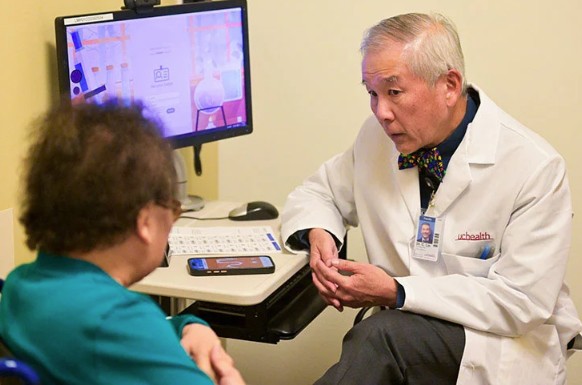
UC Health AI Tool
The Abridge program began as a pilot in 2025 with 250 UCHealth providers testing the tool. Now nearly one-third of about 6,000 UCHealth doctors, nurse practitioners and physician assistants are using Abridge. The AI tool has been so popular that leaders plan to keep expanding access to Abridge, said Dr. CT Lin, UCHealth’s chief medical information officer and an internal medicine doctor who sees patients at UCHealth Internal Medicine – Lowry in Denver.
Abridge uses the provider’s smartphone as an audio recorder, sending encrypted voice files wirelessly and directly to UCHealth’s secure, HIPAA-compliant Epic electronic health record while storing nothing on the smartphone itself.
Abridge benefits patients in many ways. It lets providers focus fully on the conversation without worrying about documenting the visit. The AI tool also captures details a physician might otherwise miss.
Lin gave the real-world example of a patient visit focused on chronic health issues. The topic of a small bump on the patient’s wrist came up.
“I might have put that in my note, but I might have been too busy because we were talking about diabetes and heart failure and all these other things,” said Lin, who is also a professor at the University of Colorado School of Medicine on the Anschutz campus. “It listens pretty well and puts in a lot of details.”
Further, with Abridge, patients leave the clinic with a detailed after-visit summary that captures the essence of the conversation in plain English. They also receive an updated care plan with more detail than providers could previously include. That’s because busy providers have limited time to write up notes. Often, doctors referred to charting as
“pajama time” since they had to write up notes late into the night, long after seeing multiple patients during each busy workday.
Progress notes are only part of what providers do for patients outside of clinic visits. Tanaka says a typical day might also drop 20 My Health Connection messages into his inbox. There may be 10 pharmacy refills to prescribe, phone calls to make to insurers, and various documents to review and sign. Those all take precedence, Tanaka says, leaving the progress notes for later.
“At the end of the week, I could have 20 or 30 notes I have to finish,” Tanaka said. With Abridge, he typically finishes progress notes right after clinic and heads home with a clean slate. “I tell my wife, ‘I finished all my notes,’” Tanaka said. “She looks at me and says, ‘Wow.’”
That’s a nontrivial “wow.” Saving a couple of hours a night, or several hours at the end of a long week, can help address physician burnout, which was one of the main motivations behind the development of Abridge. About 45% of doctors reported at least one sign of burnout in the American Medical Association’s most recent survey on the topic. Burnout affects patients and physicians alike, as it can lead to worse patient outcomes and lower quality of care. Article courtesy of UC Health.