
In October, Colorado University’s Anschutz’s Medical Center held their annual all-day Geriatrics Symposium at their Aurora campus. Over 250 people and multiple vendors in many medical and healthcare professions attended the event! After the light breakfast, host and Geriatrics Chair Cari Levy, MD & PhD, provided the welcome introduction followed by the opening keynote speaker, Dr. Kerri Moreau, geriatrics professor at Anschutz.
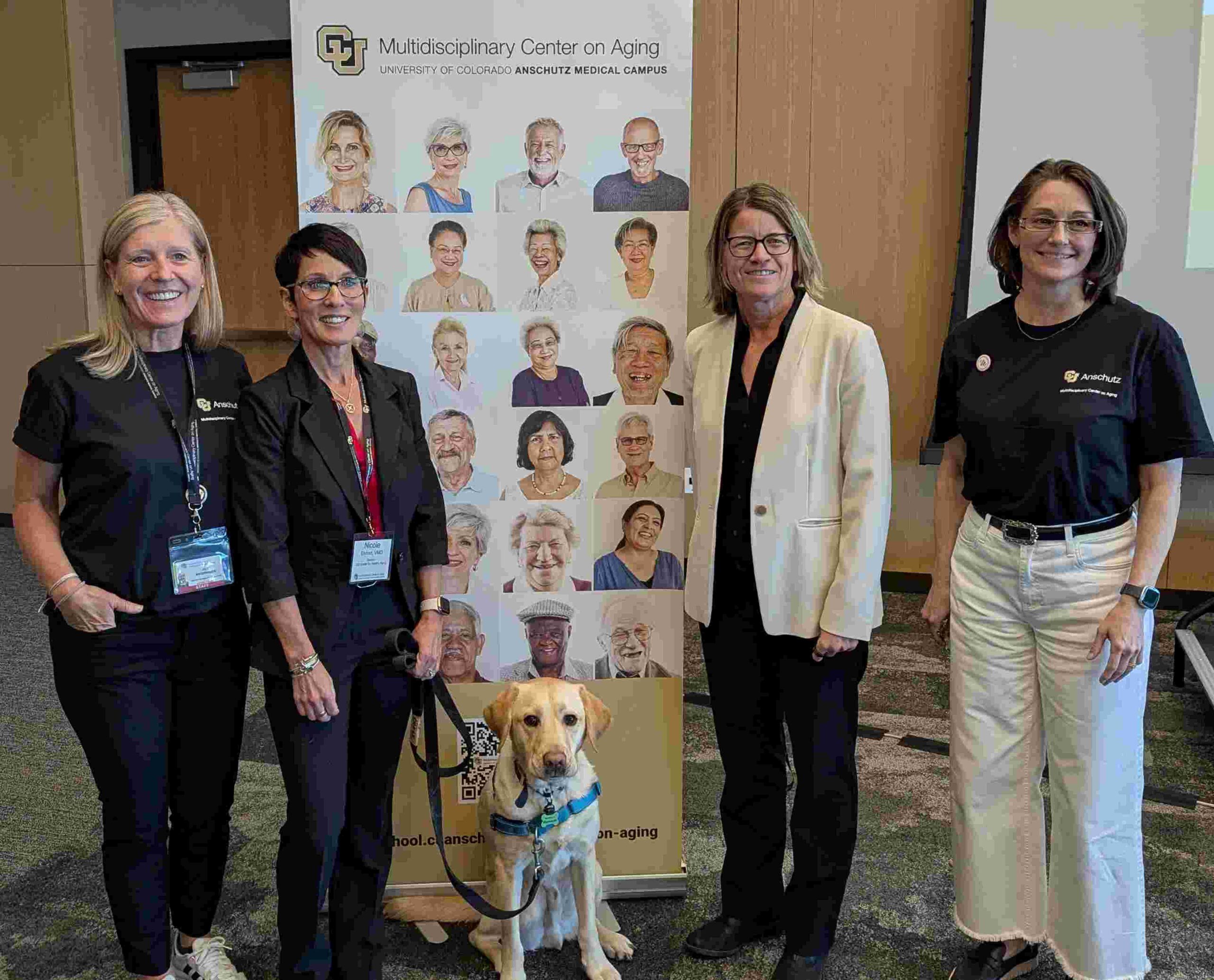
Anschutz Geriatrics Conference Speakers (l-r) Jodi Waterhouse, MHA, Dr. Nicole Ehrhart, DVM w/her therapy dog Mammoth, Dr. Kerrie Moreau, MD, & Dr. Cari Levy, MD & PhD
Kerri spoke about Vascular Aging from Head to Toe! She explained that most seniors over 60 years have arterial stiffness and thickness of their blood vessels, that affects women after menopause usually after 4o years of age. Reversing artery hardening is difficult to do, however exercise and proper nutrition help to reduce artery thickness!
Alzheimer’s and kidney disease, bone deterioration also affects more women more than men, whereas muscle deterioration affects more men! Women taking hormonal therapy will last 15 years longer than average. Statin prescriptions do improve blood pressure by reducing cholesterol levels in both sexes. Interesting, she elaborated that testerone therapy treatment didn’t improve aging for men!
The conference had multiple breakout sessions throughout the day, which I only attended several sessions that interested me. Other breakout sessions not attended included your feet, ears, retinal aging, cancer in older adults, oral health, knees, caregiving tips, weighted vests, skin issues, and arthritis.
Dr. Victoria Pelak, professor of Neurology & Opthalmalogy at Anschutz, discussed vision & cognitive issues! She indicated age related ocular changes causes presbyopia, which is the age-related loss of the eye’s ability to focus on nearby objects, typically beginning after age 40. It’s caused by the gradual stiffening of the lens inside the eye, making close-up tasks like reading more difficult! Diabetes and cardio effects make it even worse!
Certain drugs such as antidepressants, antihistamines, and diuretics are causes, but several treatments include reading glasses: either bifocals or progressive lens or contact lens too
!
Victoria mentioned 25% of the brain is dedicated to your vision. It also controls your physical movement, recognition & memory, and decision making! Several eye defects include cataracts, macular degeneration, glaucoma, but are treatable!
Eye diseases affects understanding (comprehension) and dementia, however routine annual testing can maintain a healthy lifestyle with diet, exercise, socializing, and intellectual stimulation!
Lauren Beenken & Catherine O’Hara, graduate audiologist students at Anschutz, discussed how diabetes and hearing affect lifelong health. Sadly, 38.4 million Americans have diabetes, while 98 million Americans are near diabetic stages. Diabetes is the 8th leading cause of death, and most cases can be treated or reversed in some cases.
Diabetes affects many parts of the body including the heart, eyes, feet, nerves, blood vessels, stomach, brain, skin, kidneys, sexual habits, mouth, and hearing including your balance! Other causes are neuropathy, high blood sugar, speech effects, falling down, impaired visual acuity, diminished posture, increased risk of noise exposure and using ototoxic drugs.
Expect higher frequency loss in hearing from noise levels greater than 60 decibels (db), but lower than 60 db results in normal hearing! The effects of hearing loss includes social isolation and loneliness in most Americans, decreased mental health and higher cognitive decline problems, fatigue, and decreased memory. Dementia increases hearing loss of 200 to 500% in many Americans. Healthcare providers refer patients to audiologists for a hearing evaluation and likely will need hearing aids as needed.
Both students recommended regular hearing screenings and protect your hearing in noisy areas, which can cause tinnitus (constant buzzing) from constant high levels of noise such as loud music or construction in any environment!
Dr. Samantha Farro, PhD and assistant professor in Geriatrics, discussed issues from stress during challenging times. A 2024 survey of 3300 adults on the stress topic affected 77% of our nation, 73% of our economy, and 69% of the 2024 election results. 4 of 5 adults felts the last election was a rollercoaster ride with 25% of Americans losing sleep over the election results.
She elaborated on the fact that 50% of adults were less likely to connect with people due to stress! For example, 30% of family members didn’t interact with each other due to differences in values, especially politics! Over 70% felt there was too much misinformation in today’s world, while 80% lost the ability to have civil disagreements and were emotionally stressed!
However, there are three components: 1) self kindness, 2) common humanity interaction, & 3) mindfulness (a relaxing technique) that has positive health benefits for reducing stress!
Dr Hilary Lum, MD & PhD, professor of Geriatrics, provided tips for navigating caregiving for others and ourselves. She explained caregiving is hard, complex , and very common for most adults! 51% of caregivers felt a sense of purpose as a caregiver! Caregiving affects psychological social, spiritual, emotional, and educational needs!
Always ask for caregiving help through a friend or a coalition group referrals or from your local Area Agency on Aging (AAA) facilities including online help! Many coalition groups and AAAs offer caregiving classes to prevent or reduce stress as a caregiver!
In 2024, 6.9 million Americans had Alzheimer’s Disease (in various stages), while 1 million Americans had severe dementia of other types! These types of dementia cost our nation over $215 billion annually! Just in Colorado, 159 thousand professional and personal caregivers provided over 184 million hours of caregiving services! Sadly, over 64% of caregivers have high stress and need help!
There are many services available for caregivers such as CU Health’s GUIDE (Guiding an Improved Dementias Experience) program. Also social engagement, memory cafes, Denver Art Museum’s SPARK program, and other educational programs provided by AARP and Alzheimer’s Assn.
Dr. Thomas Johnson, MD and assistant professor of Geriatrics, provided information on fall prevention. Every second, an older adults falls! In Colorado, 1 in 3 adults fall down causing major injuries or even death! Between 2020-24 nationwide, there were 4,300 deaths attributed to falls! There are six recommended steps to fall prevention: 1) Balance & exercise programs, 2) Talk to your primary care physician about fall prevention and evaluation, 3) Review your medications as many are linked to balance issues and falling down, 4) Vision and hearing evaluations, 5) Home safety issues in your bathroom involving your rugs, lighting, railings, and shoe safety. and 6) Talk to your community about fall prevention services! Local AAAs and the CDC offer fall prevention classes.
Dr. Alex Garbin, DPT & PhD, assistant professor of Physical Therapy, explained the Need for Speed in Walking. Walking fast is beneficial to your health! Past surveys indicate slower walking speed causes health problems. Walking less than 0.6 meters per second shortens your life,,whereas walking 1.2 meters per second is best for walking and extending longevity. Walking 0.6 meters per second would be normal for adults over 80 years od age!
Dr. Danielle Wilhour, MD and assistant professor in Neurology, discussed the causes, care, and comfort of headaches. This affects 50% older adults over 65 years of age and affects 50% of the world’s population!
There are two types of headaches: 1) primary which includes the painful migraines, tension, cluster, and hypnic types, and 2) secondary, which includes sleep apnea, sinus, neck, & great cell types!
The symptoms can be different in older adults! Red flags include getting headaches after 50 years of age, worse when coughing, and neurology changes! Patients may need extensive evaluation involving CAT or MRI scans, blood tests, and possibly a spinal tap to detect causes of headaches!
Migraine headaches are the hardest to resolve as many causes are linked to smell, food, light, and sound, but normally disappear over 65 years of age. Women are three times more than men of having migraines due to female issues!
However since the 1980s, several medications have helped to reduce headaches including asprin for secondary types, but several FDA-approved medications can help prevent or reduce migraine headaches, including beta-blockers, anticonvulsants, CGRP inhibitors, antidepressants, and Botox for chronic cases.
Dr. Amy Schell, MD, discussed obstructive sleep apnea (OSA) on treatment strategies. Sleep apnea patients have reduced headaches using CPAP machines to increase oxygen levels during sleep. Some patients have had throat surgery, which has been only 40% effective! Even bone surgery is about 80 % effective.
The latest neurostationary method uses a thin wire from a battery pack connected to the patient’s tongue nerve which moves the tongue to open the airway for increasing oxygen levels hasproven t be 80% effective! Sleeping on the side has helped reduce OSA levels. The latest development now uses medication for OSA, which is unknown on its effectiveness!
Dr. Dr. Nicole Ehrhart, DVM & MD, veterinarian at Colorado State University and Director of the Center for Healthy Aging was the closing keynote speaker on the science of healthy longevity. She brought her therapy dog, Mammoth, which enjoyed meeting the attendees!
Nicole elaborated on aging for Americans during the 1800s on life expectancy lasted 35 years, whereas today Americans expectancy can be up to 80 years of age. American are living longer, but not healthier due to the many chronic diseases Sadly, 24% of the global population lives to be 65 years due to the amount of worldwide diseases!
Today, Americans live with one chronic ailment by age 60, but is increasing to two chronic ailments by age 80! Aging is the common risk factor for living longer. Scientists predict today’s child could live to be over 140 years with the proper nutrition and exercise!
Thanks to these beneficial medical professionals for their outstanding research in helping our senior Americans live a better and healthful life! Article & photo courtesy of photojournalist Robert Larson.