
Christmas or Feast of the Nativity is an annual festival commemorating the birth of Jesus Christ, observed primarily on December 25 as a religious and cultural celebration among billions of people around the world. Christmas Day is a public holiday in many of the world’s nations is celebrated religiously by a majority of Christians as well as culturally by many non-Christians and forms an integral part of the holiday season centered around it.
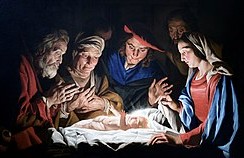
3 Wise Men Witnessing Birth of Jesus
In the 2nd century, the “earliest church records” indicate that “Christians were remembering and celebrating the birth of the Lord,” an “observance that sprang up organically from the authentic devotion of ordinary believers”; although “they did not agree upon a set date”. The earliest document to place Jesus’s birthday on December 25 is the Chronograph of 354 (also called the Calendar of Filocalus), which also names it as the birthday of Sol Invictus (the ‘Invincible Sun’)
Although the month and date of Jesus’ birth are unknown, the church in the early fourth century fixed the date as December 25, which has been adopted almost universally throughout the world. In 1843, Charles Dickens wrote the novel A Christmas Carol, which helped revive the “spirit” of Christmas and seasonal merriment. Its instant popularity played a major role in portraying Christmas as a holiday emphasizing family, goodwill, and compassion.
Dickens sought to construct Christmas as a family-centered festival of generosity, linking “worship and feasting, within a context of social reconciliation.” Superimposing his humanitarian vision of the holiday, Dickens influenced many aspects of Christmas that are celebrated today in Western culture, such as family gatherings, seasonal food and drink, dancing, games, and a festive generosity of spirit. It has been said that Dickens’ breakthrough with A Christmas Carol was his “ingenious pairing of seasonal fiction and seasonal [book] sales.” A prominent phrase from the tale, “Merry Christmas”, was popularized following the appearance of the story. The Christmas tree was first used by German Lutherans in the 16th century, with records indicating that a Christmas tree was placed in the Cathedral of Strassburg in 1539. In the United States, these “German Lutherans brought the decorated Christmas tree with them; the Moravians put lighted candles on those trees”. When decorating the Christmas tree, many individuals place a star at the top of the tree symbolizing the Star of Bethlehem, a fact recorded by The School Journal in 1897.
The celebratory customs associated in various countries with Christmas have a mix of pre-Christian, Christian, and secular themes and origins. Popular modern customs of the holiday include gift giving; completing an Advent calendar or Advent wreath; Christmas music and caroling; viewing a Nativity play; an exchange of Christmas cards; church services; a special meal; and the display of various Christmas decorations, including Christmas trees, Christmas lights, nativity scenes, garlands, wreaths, mistletoe, and holly.
In addition, several closely related and often interchangeable figures, known as Santa Claus, Saint Nicholas, and Christkind, are associated with bringing gifts to children during the Christmas season and have their own body of traditions and lore. Because gift-giving and many other aspects of the Christmas festival involve heightened economic activity, the holiday has become a significant event and a key sales period for retailers and businesses. The economic impact of Christmas has grown steadily over the past few centuries in many regions of the world. Article courtesy of Wikipedia.